


Give education video, and it lectures into homes. Give it the internet, and it distributes courses. Give it analytics, and it refines assessment. Give it generative AI, and it builds a tutor.
These applications can improve learning and widen access while leaving the educational model almost untouched. In essence, we are using new technologies to do the same old stuff.
In earlier work, I argued that mainstream education warrants scrutiny precisely because it does what it is designed to do. Much of edtech is devoted to perfecting a machine that mainstream schooling has already spent more than a century refining. Its functions are well established: classify learners, schedule their time, sequence instruction, assess achievement, rank performance, and certify completion. An institution can improve its performance at each while offering learners very little additional authority over their education. A faster route through the same curriculum is still the same curriculum.
Courses, assignments, timetables, tests, and credentials have established budgets and purchasers. Designing for them makes commercial sense, but their suitability for procurement cannot establish their adequacy for learning. If the educational model enters the product brief as a fixed requirement, transformation has already been bounded.
A student’s improved understanding deserves recognition, and an effective tool can justify its use through that contribution. Claims of transformation require a different standard: which educational decisions has the product reopened?
Edtech has spent decades optimizing mainstream schooling. What forms of education become possible when its organizing assumptions become open to design?
Before asking whether a product transforms education, we should ask what justified buying it. UNESCO’s 2023 Global Education Monitoring Report cites a survey across 17 US states in which only 11% of teachers and administrators requested peer-reviewed evidence before adopting educational technology.
of surveyed teachers and administrators requested peer-reviewed evidence before adopting educational technology.
When a vendor promises educational transformation, what evidence do we require before committing money, teachers’ time, and learners’ attention? And are we making purchases with an intent to actually change anything? Is it no wonder that classrooms of the 21st century look no different than in the 19th or 20th centuries?


.jpg)
Schools domesticate educational technology
The historical literature helps explain why technical innovation so often preserves familiar educational arrangements. Tyack and Tobin (1994) used the concept of the “grammar of schooling” to examine the persistence of such features as age grading, divisions of knowledge, and allocations of instructional time. These arrangements acquire legitimacy through institutional practice and public expectations about what a school should look like. Their historical durability makes alternatives difficult to recognize as credible education, even when those alternatives offer substantive possibilities for learning.
Tyack and Cuban’s (1995) account of school reform further explains how institutions modify innovations as they incorporate them. Papert (1997) described this process in the treatment of computers: uses that crossed curricular boundaries were contained through separate laboratories and a computer curriculum. The institution accommodated the technology while restricting its capacity to disturb the organization of learning. His emphasis on evolving learning cultures also challenged the expectation that educational change could be imposed through a fully specified reform plan.
The contemporary relevance lies in the decisions that remain protected from change. An adaptive platform can vary pace, difficulty, and presentation while preserving the institution’s authority over objectives, sequence, and assessment. Learners gain choices about how to pursue purposes established by others, while authority over those purposes remains concentrated where it was before.
Personalization without authority is customization.
Those choices may support learning; claims to expanded agency also require opportunities to question and revise the decisions governing it.
Seven assumptions embedded in mainstream educational design
These assumptions rarely appear in product descriptions because they are usually treated as givens. Yet once encoded into software, they become conditions of participation. The seven assumptions below draw on Tyack and Tobin (1994), Tyack and Cuban (1995), Biesta (2009), and Selwyn (2022). They identify choices to examine, including who can revise them.
Table 1
Seven Assumptions Embedded in Mainstream Educational Design
| Assumption embedded in educational design | How a product may preserve it | Question for educational design |
|---|---|---|
| Educational participation can be bounded by institutional space. | Virtual classrooms and course workspaces retain institutional boundaries around participation. | What arrangements would support inquiry across community, workplace, public, and institutional settings, with equitable access to people and resources? |
| Learning can be organized through standardized allocations of time. | Attendance, credit hours, deadlines, and time online organize progression and supply proxies for learning. | Which temporal requirements support learning, and which primarily serve administration? How could duration and progression respond to evidence of understanding? |
| A prescribed sequence can accommodate the learning that matters. | Adaptive pathways vary pace or difficulty within a prescribed curricular progression. | Which prerequisites are warranted by the inquiry, and who can challenge or revise the sequence? |
| Measured outcomes adequately represent educational value. | Scores, completion rates, and engagement indicators delimit the achievement a system recognizes. | What capacities and experiences do these measures omit, and how will judgments about their educational significance be made? |
| Educational ends can be specified in advance. | Learning objectives and success criteria remain fixed as learners encounter new questions and obligations. | How can learners and communities participate in defining purposes and revising them through inquiry? |
| Learners and knowledge can be divided into age cohorts, subjects, and courses without unacceptable educational loss. | Enrollment rules and content structures reproduce age grouping and disciplinary separation. | When would shared problems, intergenerational participation, or connections across disciplines provide a stronger basis for organization? |
| Improvement consists in optimization. | Development prioritizes speed, throughput, cost, or performance against established targets. | Who authorized the target, whose interests does it serve, and what educational possibilities become harder to pursue when it dominates? |
The table identifies decisions with administrative as well as educational consequences. Shared schedules coördinate provision, disciplinary boundaries support specialized study, and common curricula can protect access to knowledge. Those benefits require consideration alongside the possibilities each arrangement forecloses. A timetable may be necessary to organize staffing without providing a defensible account of how long understanding should take. Age grouping may simplify enrollment without determining who could learn productively together. Problems arise when an arrangement’s usefulness for administration becomes sufficient justification for governing learning.
Once an assumption becomes software, it acquires the force of infrastructure. An enrollment rule, content hierarchy, or completion requirement becomes something participants must comply with to proceed. Educators may recognize a learner’s development and still lack the ability to record it because the system recognizes only the prescribed category. The design has then settled an educational question through an administrative restriction. Making such restrictions faster or more consistent can deepen their influence.
Better outcomes leave educational purposes open to question
Evidence of effective edtech makes the limits of transformation claims more precise. Kulik and Fletcher’s (2016) meta-analysis of 50 controlled evaluations of intelligent tutoring systems reported a median test-score effect of 0.66 standard deviations relative to conventional instruction. In a randomized crossover study of 194 Harvard physics students, Kestin et al. (2025) found greater immediate learning gains with a carefully designed AI tutor than with in-class active learning. Across two lessons, the tutor varied location and pace while retaining prescribed content, assessment goals, and problem sequence. Real gains accompanied continuity in educational purpose.
Design also affects whether assistance produces learning. In an experiment with nearly a thousand high school mathematics students in Turkey, Bastani et al. (2025) found that a general-purpose GPT-4 interface improved practice performance but reduced subsequent unaided exam performance relative to the control group. Teacher-informed safeguards largely eliminated that disadvantage without demonstrating a positive effect on unaided exam performance. Such findings support judgments about specific tools, uses, and outcomes; retention and transfer require their own evidence.
Evidence that students reach a prescribed outcome more efficiently cannot establish who should prescribe the outcome. Instructional efficacy leaves us responsible for examining the educational ends against which efficacy is judged, including who can contest them.
When technology obscures learning
In Aprendizaje Invisible, Cristóbal Cobo and I examined learning that escapes institutional recognition (Cobo Romaní & Moravec, 2011). Foregrounding technology can obscure that learning: institutions report usage and completion while overlooking the conversations, experimentation, and informal strategies through which understanding develops. Teachers may compensate for inadequate feedback, peers may resolve confusion the system fails to recognize, and learners may develop understanding elsewhere before returning to record completion. A platform’s record can consequently conceal both learning outside its categories and the human work that overcomes its limitations. Learning may occur through the technology, alongside it, or despite it.
Every product distributes educational authority
Biesta (2009) argues for reconnecting evaluation with educational purpose. His distinction among qualification, socialization, and subjectification identifies different dimensions of educational responsibility: developing knowledge and capacities, participating in social practices and traditions, and existing as a subject capable of independent action. Judgments about good education concern their relationships and tensions.
This framework places an obligation on claims of effectiveness. Researchers and developers must explain which purposes their outcomes represent and how improvements relate to other educational commitments. A measure can be valid for a particular construct while remaining insufficient for the broader judgment attached to it. Engagement, for example, requires an account of what people are engaged in and why that activity deserves their attention.
Selwyn (2022) likewise situates educational technology within social and institutional relations. Building on that perspective, product governance belongs within the evaluation of educational design. Decisions about enrollment, categorization, recommendation, and assessment distribute authority among learners, educators, institutions, and vendors. Their consequences extend beyond an interface’s usability.
Participation in implementation should therefore be examined in relation to participation in decisions. Consultation after a platform has been purchased gives a community a different kind of influence from involvement in defining the educational problem. An educator’s ability to adjust a dashboard may leave its categories beyond challenge. These distinctions concern whose judgment the institution permits to count. A product roadmap is an allocation of educational authority, with consequences for everyone expected to learn or teach within its decisions.
The economics of appearing to change
The institutional economy of edtech can reward activity that leaves educational assumptions undisturbed. Procurement produces contracts, implementation produces training, and monitoring produces reports that inform renewal. Each stage generates evidence of work completed and can support legitimate institutional needs. The difficulty arises when successful implementation becomes sufficient evidence of educational transformation. Moving a course online or automating assessment demonstrates a change in delivery or administration; the claim that education has been transformed requires evidence about what has changed in learners’ opportunities, purposes, and authority.
The financial stakes demand scrutiny. UNESCO’s 2023 Global Education Monitoring Report calls for evaluation of total ownership and implementation costs, transparency in public spending, and attention to maintenance and subscriptions. It also identifies a shortage of reliable, consistent cost information. Purchasers must account for both the full cost of a product and the evidence supporting its educational claims. Successful adoption cannot settle either question.
The delusion of transformation is sustained when expenditure, adoption, and implementation substitute for examining the educational proposition. Even genuine instructional gains can coëxist with an unwillingness to question how schooling organizes learning. Institutions can consequently spend heavily producing evidence of technological change while leaving their assumptions intact. The opportunity cost extends to educational possibilities that receive no funding because they require a different timetable, enrollment structure, or understanding of achievement. The most expensive assumption in education may be the one nobody remembers choosing: its costs recur through purchases that make it increasingly difficult to reconsider.
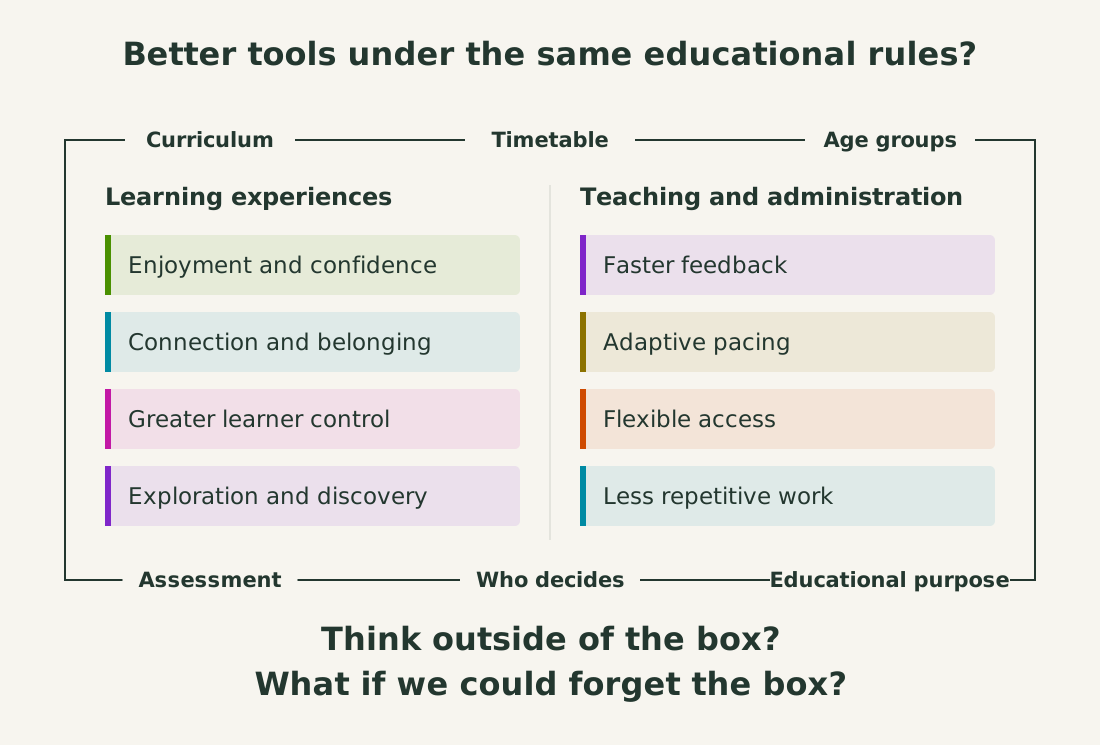
What might we build if the assumptions were variable?
Opening these assumptions to design changes the brief. The time available for inquiry can respond to its demands. Age grouping can be reconsidered, disciplinary boundaries crossed, and objectives revised as learners encounter new questions. Assessment can become a subject of deliberation, with its categories and judgments available for examination. These changes reach decisions usually settled before a tool encounters a learner.
Institutions remain responsible for the conditions that make agency possible: expertise, guidance, time, resources, safeguarding, and equitable provision. Giving learners nominal choice while withdrawing those supports can deepen inequality. Reconsidering how schooling works requires institutions to take those public obligations seriously, including when evaluating existing arrangements.
The unresolved question is how much of schooling we are willing to reconsider. A product can earn its place through better feedback, wider access, or richer learning experiences. Claims of transformation should identify which educational decisions have changed, and who has gained authority over them.
The more capable the technology becomes, the harder it is to justify treating the educational assumptions around it as fixed.
References
Bastani, H., Bastani, O., Sungu, A., Ge, H., Kabakcı, Ö., & Mariman, R. (2025). Generative AI without guardrails can harm learning: Evidence from high school mathematics. Proceedings of the National Academy of Sciences, 122(26), e2422633122.
Biesta, G. (2009). Good education in an age of measurement: On the need to reconnect with the question of purpose in education. Educational Assessment, Evaluation and Accountability, 21, 33–46.
Cobo Romaní, C., & Moravec, J. W. (2011). Aprendizaje invisible: Hacia una nueva ecología de la educación. Laboratori de Mitjans Interactius / Publicacions i Edicions de la Universitat de Barcelona.
Kestin, G., Miller, K., Klales, A., Milbourne, T., & Ponti, G. (2025). AI tutoring outperforms in-class active learning: An RCT introducing a novel research-based design in an authentic educational setting. Scientific Reports, 15, Article 17458.
Kulik, J. A., & Fletcher, J. D. (2016). Effectiveness of intelligent tutoring systems: A meta-analytic review. Review of Educational Research, 86(1), 42–78.
Papert, S. (1997). Why school reform is impossible (with commentary on O’Shea’s and Koschmann’s reviews of The Children’s Machine). The Journal of the Learning Sciences, 6(4), 417–427.
Selwyn, N. (2022). Education and technology: Key issues and debates (3rd ed.). Bloomsbury Academic.
Tyack, D., & Cuban, L. (1995). Tinkering toward utopia: A century of public school reform. Harvard University Press.
Tyack, D., & Tobin, W. (1994). The “grammar” of schooling: Why has it been so hard to change? American Educational Research Journal, 31(3), 453–479.
UNESCO. (2023). Global education monitoring report 2023: Technology in education: A tool on whose terms?. UNESCO.