 John Moravec
No hope without action
Note. This preface originally appears in the book, Build a Positive Rebellion: Create New Education Futures.
Nothing is more political than education. Like politics, it stands at a breaking point. The old assurances that schools would open doors, guarantee mobility, and prepare people for the future are coming apart in real time. Institutions built on those promises strain under their own contradictions. Classrooms stay full. Degrees keep flowing. Ceremonies proceed as always, while the meaning beneath them grows thin. Public trust in education as a path to progress erodes month by month. We face a stark paradox. Never have so many people around the world pursued formal schooling, and never has its value felt so uncertain. Algorithms rearrange the boundary between fact and fiction. The rise of authoritarian power narrows what people can say or do. The shadow reaches into daily life, beyond abstraction.
The cracks are easy to see. The factory model of schooling, a product of industrial modernity, shaped education to meet the needs of bureaucracies and assembly lines. The industrial assembly line lives on in age-graded cohorts, bells that dictate the beginning and end of thought, and standardized curricula that treat teachers as delivery mechanisms. Students conform to institutional routines, while institutions rarely adapt to students. Sorting, compliance, and efficiency overshadow inquiry. Curriculum narrows into checklists. Young people learn to game the system for grades and credentials even when real learning is thin. Many learn to hide curiosity to survive.
The social contract that once animated this system has broken. The promise of “work hard, achieve, and secure a happy retirement” no longer matches lived realities. Graduates face precarious labor markets, rising costs, and widening inequality. Credentials function less as gateways than as costly filters. Institutions, meanwhile, extend study and debt not to support growth but to delay a reckoning with economies unable to absorb the graduates they produce. The system sustains itself by promising more than it delivers and monetizing the gap.
This is a cultural crisis as much as an economic one. The rituals of lectures, exams, and graduations can feel like theater when outcomes fail to meet expectations. Families press children to succeed out of fear rather than confidence. Even those who excel by institutional measures often describe a misalignment between what they were taught and the realities they face. Trust erodes in schools, in leadership, and in the very idea of education as a public good.
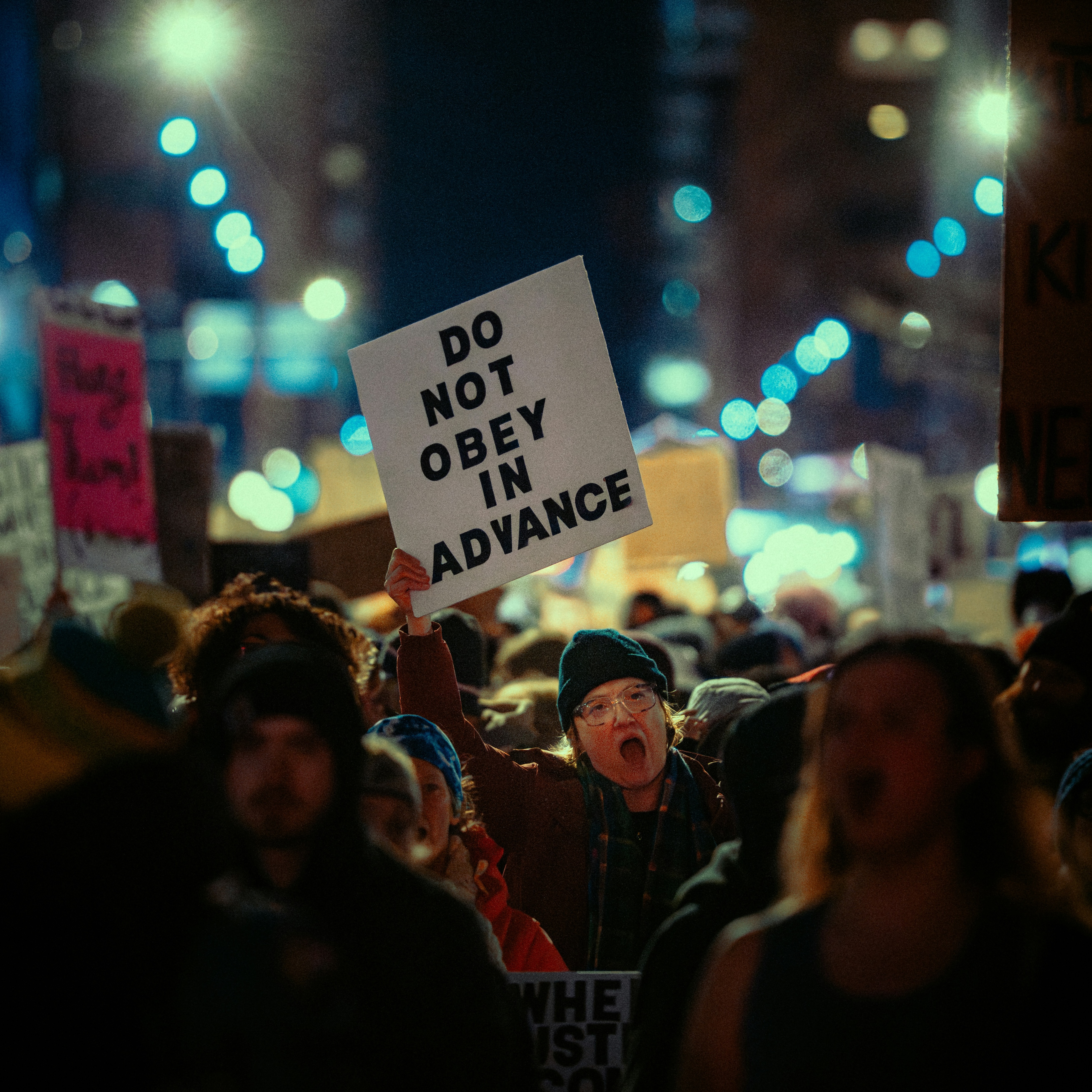
In this vacuum, authoritarian politics thrive. Power tests how far it can push before people rebel. We see it now, as I write, in Minneapolis, where federal force meets neighborhood resistance with weapons, surveillance, and intimidation. From this city to many others, the march away from freedom spreads. Schools are pulled into culture wars. Unitary executive power defines which topics are permissible. Textbooks are sanitized. Libraries face censorship campaigns. Teachers are monitored. Dissent is punished. The rhetoric of restoring discipline, returning to standards, and protecting children sounds protective, yet it suffocates because it is used as a weapon against children. Inquiry becomes disloyalty. Complexity becomes a threat. The classroom becomes a stage for political control, not a space for thought.
When the people resist, the habits learned in classrooms decide whether they acquiesce or stand beside their neighbors.
Of course, I write from one place and one history, aware that other regions reached this crisis by different paths, through colonial extraction, linguistic exclusion, and uneven access to power. Yet struggles over power, and the tools used to shape learning, echo across cultures.
Existing pressures tighten, and their pace and scope outrun every familiar response. Artificial intelligence and allied technologies remake knowledge, work, and human interaction, yet schools answer by mechanizing habits that already failed. Platforms sold as innovation sort learners, monitor attention, and predict behavior with a precision no person should wield. Algorithms enforce obedience without pathways for appeal. Instruction changes little; the apparatus of control accelerates exponentially with computational power.
This failure is dangerous. Technologies, especially AI, are not built to serve education; they are built to serve markets and the interests of a few owners. They can reinforce bias, expand surveillance, and commodify student data. When institutions resist adaptation, they convert students into data sources and training material for platforms they do not control. Obsolescence and exploitation become features of the system, not consequences. The challenge is not to fit AI into schooling as it exists, but to reimagine education in light of what these technologies mean for learning, agency, and human futures.
Meanwhile, planet-wide crises demand new forms of learning to meet emerging dilemmas. Climate disruption, pandemics, mass displacement, and algorithmic governance are present threats. Yet education often proceeds as if the future will mirror the past, updated with new devices. Students eager to prepare for tomorrow instead encounter yesterday’s solutions, stripped of relevance. Carefully programmed pathways toward achievement falter when learners and institutions meet real complexity.
When learning is reduced to indoctrination, the pursuit of truth gives way to the preservation of power. Students receive orders instead of agency and freedom. Universities, too, risk silence when reputational or financial pressures outweigh academic freedom. When curiosity and courage are no longer nurtured, civic life narrows and the potential for self-actualization diminishes.
This raises a core question: what is education for, if it cannot prepare people to defend truth, dignity, and the capacity to thrive together in this century? Adding courses, layering devices, or outsourcing direction to markets does not resolve structural problems. These responses keep institutions running on life support while preventing renewal.
This book was nearly titled No hope without action, after long conversations about what “hope” really means. Nietzsche (1996) called hope the cruelest evil, left in Pandora’s jar to prolong human torment. Paulo Freire (1994) answered with critical hope, a hope tied to struggle and practice rather than passive waiting. Erich Fromm (1992) described hope as an active orientation, an inner readiness for the possible that resists passivity and insists on engagement. Between these views lies our concern: hope can sustain us, but without action it becomes an excuse for maintaining the status quo.
In moments like this, action cannot stay inside the lines. Institutions trained on compliance treat dissent as a defect and call it order. They absorb polite critique, then continue as before. If education is going to serve dignity, truth, and self-determination, we must refuse the practices that train obedience and build new ones in public. We need a positive rebellion.
Thus, this book’s title leads us toward an answer to that question with an orientation and a method. Build a Positive Rebellion relates to a disciplined refusal of practices that harm, narrow, or disable people, paired with the work of constructing better options in public view, where learners, families, and communities can see, shape, and hold them accountable. Positive means constructive, grounded, and accountable to learners and communities. Create New Education Futures uses the plural form of “future” on purpose, because contexts differ and no single model should claim universal authority. We cannot know the future with certainty, but we can choose what guides us as we build our best futures.
And yet, hope endures. People cling to education because they still believe in its deeper promise: a shared practice of making meaning, building capacity, and shaping futures together. No other institution carries as much trust. The question is whether this promise can be recovered before the contradictions of the old model trigger collapse.
Identifying the problem is the first step. As this preface noted at its beginning, education is political. It produces inequality while promising mobility. It markets innovation while clinging to inherited paradigms. It invokes freedom while enforcing compliance. Superficial adjustments cannot resolve these tensions. Education must be redesigned to center lived experience, cultivate agency, and meet the demands of this century.
Redesign also requires a new relationship to knowledge. Information can be stored. Knowledge emerges when people make meaning and act on it. Systems that reward recall over understanding collapse these levels into one. The remedy is not to lower standards, but to move rigor elsewhere: ask real questions, wrestle with uncertainty, test models, publish work that matters, and revise in public. Rigor must be evidence-driven, but the evidence should reflect authentic learning (e.g., performances, prototypes, portfolios, impact), not narrow metrics.
Technology belongs in this redesign, but with purpose. Tools extend human capacities when they support modeling, design, collaboration, creation, and judgment. They distract when they automate judgment, reward spectacle, or surveil without trust.
Equity, planetary citizenship, and ecological realities must be built into education. Systems that reproduce predictable gaps by class, race, gender, language, or geography do so by design. Repair requires redesign: directing resources to sites of harm, amplifying marginalized knowledge, guiding admissions and placement, engaging families, and measuring belonging and growth rather than throughput.
Cultures of fear and control silence learners. Cultures of trust enable risk-taking. In institutions oriented toward trust, breaking rules becomes a discipline, not a reflex. Some rules safeguard equity or safety. Others persist to uphold habits that no longer serve learning. To break a rule responsibly requires naming the purpose it once served, the harm it now causes, and the standard that will replace it.
Manifesto 25 emerged as both a warning and a call to action. It rallies against schooling’s architecture of fear, anxiety, and distrust that often hides behind standardization, compliance, and credentialism. The manifesto contains twenty-five principles for rethinking education in a world shaped by ecological disruption, accelerating technologies, widening inequities, and rising authoritarianism. These principles provide foundations for building better futures, especially in places where the right to self-determination is contested. They affirm that learning is a human right, that dignity and agency are requisites for growth, that technology must serve human and planetary purposes, and that equity and shared responsibility are essential for our well-being. Together, they offer a benchmark against which we can judge whether education meets this century’s demands or retreats into the previous century’s habits.
The aim of Manifesto 25 is not to prescribe uniform solutions, but to anchor a shared orientation: principles communities can adapt, contest, and build upon in their own contexts. If we cannot know the future with certainty, we can still agree on what must guide us as we design it. Without such orientation, education drifts further behind, patching over crises instead of preparing us to meet them. With it, we have a compass for renewal.
This book is a companion to Manifesto 25. Each chapter explores one principle in greater depth, connects it with good practices, and offers guidance for action. These chapters are designed for non-sequential reading, allowing you to enter wherever the work meets your context; as you move across them, you will encounter recurring ideas that accumulate, sharpen, and test the same principles from different angles.
Interwoven throughout are two intermezzos: one collects the voices of youth confronting compliance in a world that demands agency; the other gathers reflections from signatories on where the freedom to learn is defended or constrained. Alongside these, cahiers (like the Cahiers de Doléances of the French Revolution), notebooks of ideas, grievances, and experiments, appear as spaces of testimony, critique, and design, extending the conversation beyond the text and into lived experience. The structure keeps us close to the principles while allowing practice and reflection to speak back.
This book is not a script. It offers tools and provocations. Use what helps. Set aside what does not. Add what your context requires. The manifesto calls for choices, not blind obedience. What will you defend? What will you retire? Where will you build?
The cracks in the old order are unmistakable. Whether they collapse into failure or open into renewal depends on decisions made now, in schools and ministries, in families and neighborhoods, in classrooms and councils. If education continues to manage appearances, it will keep losing trust. If it turns toward agency, meaning, equity, and planetary care, it can again become what people believe it should be: a practice of freedom, a craft of building futures, and a place where courage is learned and where rebellion becomes a form of love.
Let’s build a positive rebellion.
John W. Moravec
Minneapolis, Minnesota
April 2026