
I’ve known Peter Gray for about fifteen years. We first met in Europe, where we spoke at events organized by the European Democratic Education Community (EUDEC) and supported democratic schools inspired by the Sudbury model. We came from different academic backgrounds but shared an interest in children’s ability to direct their own learning. Those experiences brought us into contact with educators, parents, and young people who were building schools around trust, freedom, and shared responsibility.
Peter has spent decades researching play, self-directed education, and human development. I’ve followed his work with interest and affection, and our friendship has continued through our shared involvement in democratic education. He was also an original signatory of Manifesto 15 and, a decade later, Manifesto 25. I have long appreciated his willingness to question assumptions about children that have become accepted features of contemporary education.

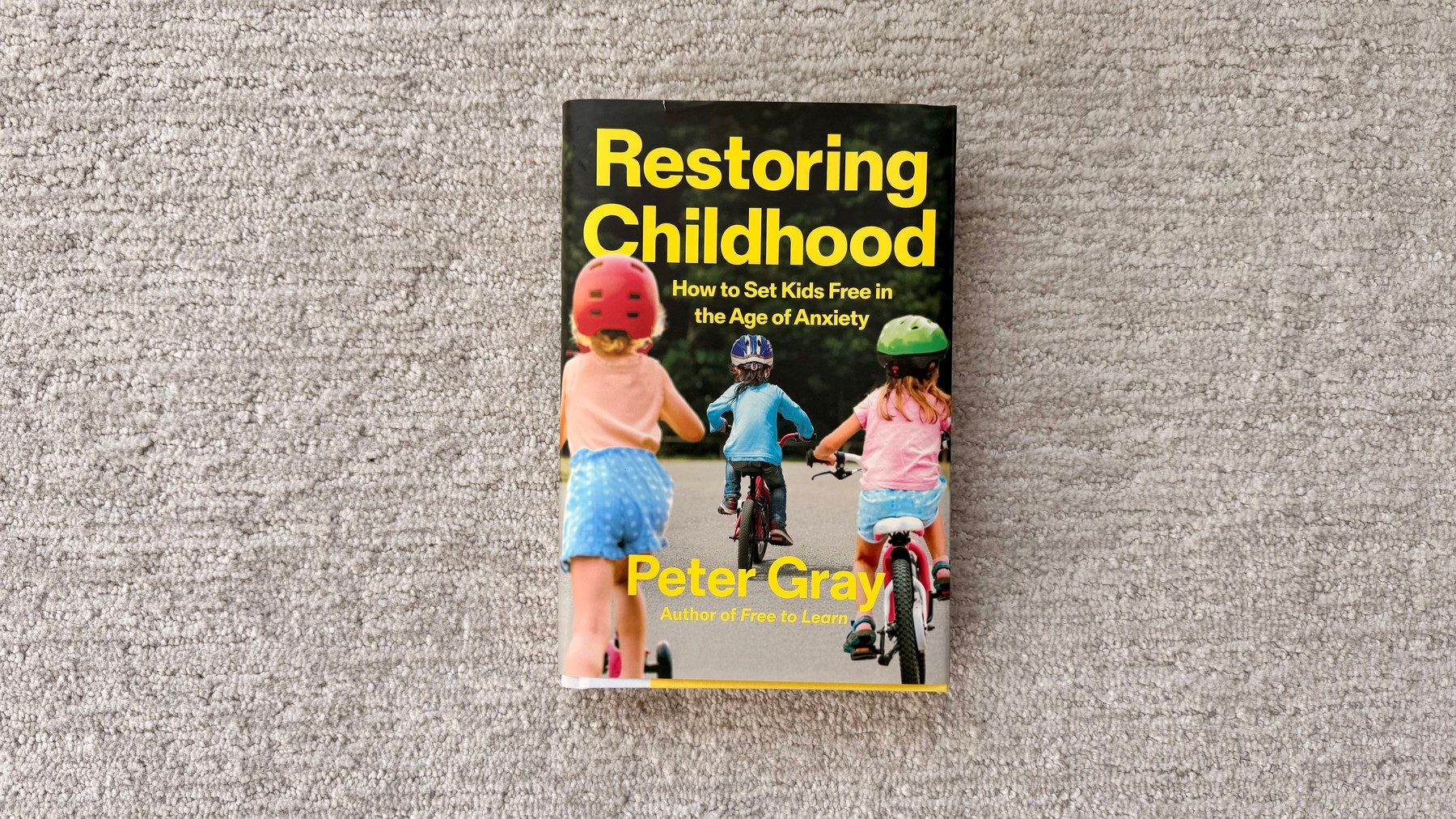
His new book, Restoring Childhood: How to Set Kids Free in the Age of Anxiety (Gray, 2026), examines how children’s opportunities for independence have diminished and what that loss may mean for their development and psychological well-being. Building on the ideas he developed in Free to Learn (Gray, 2013), Peter connects changes in parenting, schooling, neighborhoods, and public attitudes toward risk with the increasingly managed lives of young people.
Peter also challenges explanations that place smartphones and social media at the center of the youth mental health crisis. He asks readers to consider changes in children’s lives that began long before these technologies became widespread, particularly the loss of opportunities to play, explore, and make decisions independently.
Underlying his argument is an understanding of human learning that has influenced my own work for years. Children learn through curiosity, exploration, play, relationships, and the ordinary experiences of growing up. Much of this happens without formal instruction, and much of it goes unrecognized by the institutions responsible for their education.
What happened to independent childhood?
Peter opens Restoring Childhood with an image inspired by Rachel Carson’s Silent Spring. While Carson described environments in which birds had disappeared, Peter observes neighborhoods where children have largely vanished from the streets, parks, and other spaces where they once gathered independently.
The children are still there, of course. They attend school, participate in organized activities, and spend time with friends. But their opportunities to explore without supervision, invent games, resolve disagreements, and organize their own activities have declined. Scheduled playdates increasingly replace spontaneous gatherings.
Gray (2026) traces these changes through decades of increasing adult supervision, academic expectations, concerns about safety, and restrictions on children’s independent movement. He also examines how car-dependent communities, economic conditions, and changing cultural expectations have affected children’s ability to participate in everyday life.
Many of these changes emerged from reasonable intentions. Parents want to protect their children. Schools want students to succeed. Communities want to prevent harm. Few would dispute these goals. Yet the ways we have pursued them have reduced children’s opportunities to exercise independence.
Peter argues that independence contributes to children’s development because it allows them to encounter situations that require judgment, cooperation, and initiative. Through play and exploration, children negotiate relationships, confront difficulties, and discover what they can accomplish. When adults determine every activity and intervene in every disagreement, children have fewer opportunities to develop these capabilities through experience.
Restoring Childhood extends this argument into the discussion of children’s mental health. Peter examines how declining independence, academic pressure, school reform, and changes in children’s social environments may contribute to anxiety and depression (Gray, 2026).
These developments have occurred over overlapping periods, and their relationships remain important subjects for research. Longitudinal and comparative studies could help explain how children’s experiences of autonomy interact with schooling, digital media, family circumstances, and psychological well-being.
Peter’s work gives researchers a substantial set of questions to investigate.
Learning is what children do
One of Peter’s enduring contributions is his attention to the learning that takes place when children pursue their own interests.
In Free to Learn, Gray (2013) examined the evolutionary and developmental foundations of play, arguing that children possess capacities for educating themselves through curiosity, exploration, and social participation. His research focuses on learning that emerges from children’s activities rather than from predetermined educational objectives.
Consider children inventing a game. They negotiate rules, establish relationships, experiment with strategies, resolve conflicts, and adapt to unexpected circumstances. Their activities involve language, reasoning, imagination, physical coordination, and social understanding. They may acquire considerable knowledge without anyone organizing the experience around a lesson plan.
The activity has meaning because the children have chosen it. They decide what to pursue, negotiate how to participate, and discover what they can accomplish together. Learning develops through the exercise of agency itself.
I recognize these experiences from our involvement with democratic schools. In Sudbury-type environments, students exercise substantial freedom over how they spend their time and participate in governing their school communities. They pursue interests, develop relationships, seek assistance, and assume responsibilities through decisions that have consequences for themselves and others.
Peter and David Chanoff examined some of these experiences in their study of Sudbury Valley School graduates. They found that participants had pursued higher education and varied careers, and that graduates associated their schooling with the development of initiative, responsibility, curiosity, and communication skills (Gray & Chanoff, 1986).
Forty years later, these findings continue to challenge assumptions about the necessity of compulsory curricula and adult-directed instruction.
Much educational practice continues to proceed from the expectation that adults should determine what children learn, when they learn it, and how their progress should be demonstrated. Children may have opportunities to make choices within those arrangements, but adults retain authority over most consequential decisions.
Self-directed education offers a different starting point. It examines learning as something children initiate and pursue through their relationships with people, ideas, and environments. This perspective raises questions about how we organize education and how much of children’s lives institutions need to control.
An overlooked research agenda
Research on play, informal learning, and human development has produced substantial knowledge about how people learn beyond formal instruction. Developmental psychologists, anthropologists, and educational researchers have examined learning through observation, participation, social relationships, and self-directed activity.
Yet much of educational policy remains focused on improving instruction, developing curricula, measuring achievement, and evaluating interventions within existing school structures. These are legitimate areas of inquiry, but they represent only part of human learning.
For decades, researchers have examined the value of independent play and self-directed activity. We still need to understand much more about the long-term consequences of different degrees of childhood autonomy, particularly across diverse social and educational environments.
Peter’s work raises questions that deserve sustained investigation. How do children develop knowledge and capabilities when they direct substantial portions of their own activities? How does independent play influence psychological well-being? How do experiences of autonomy interact with adult support, social relationships, and community conditions? How do children educated in self-directed environments develop over time?
These questions call for longitudinal research, comparative studies, and approaches capable of examining learning that does not follow predetermined curricula. They also require attention to children living under different economic, social, and developmental circumstances.
Research on democratic schools provides one starting point, but the subject extends far beyond alternative education. Children’s experiences in neighborhoods, families, peer groups, public spaces, and digital communities also offer opportunities to understand how learning develops through participation in everyday life.
There is a larger question about the priorities of educational research itself. Governments, universities, schools, and educational organizations invest considerable resources in studying how to improve organized instruction. We know much less about how research funding and institutional priorities influence the study of learning outside those arrangements. Given the questions Peter and other scholars have raised about self-directed learning, this deserves investigation.
Research on children’s play and informal learning has existed for decades, yet its influence on educational policy appears limited. Schools continue to organize much of children’s lives around adult decisions about what, when, and how they should learn. Understanding why research on self-directed learning has had limited influence on those arrangements could be as revealing as studying the learning processes themselves.
Peter’s work offers a sustained challenge to assumptions that have shaped schooling for generations. His findings and interpretations open questions about childhood autonomy, psychological development, and the purposes of education. Those questions deserve a larger, more coordinated research effort, one willing to examine learning wherever it occurs.
Childhood belongs to children
Children’s opportunities to explore and participate in community life depend on where they live, the resources available to their families, the design of public spaces, and the relationships that support their activities. Safe places to gather, opportunities for independent movement, and access to other children all influence what freedom looks like in practice.
Democratic schools have explored some of these relationships through communities in which young people participate in decisions and share responsibility for the environments in which they learn. Their experiences suggest possibilities for organizing education around greater trust in children’s capabilities.
Peter’s new book extends the discussion to families, neighborhoods, and society more broadly. Restoring children’s independence involves reconsidering the expectations, institutions, and physical environments that shape their everyday experiences (Gray, 2026).
Childhood deserves recognition beyond its developmental benefits. We have become accustomed to explaining children’s activities according to the educational outcomes they produce. Play develops social skills. Exploration encourages curiosity. Friendships provide opportunities to practice cooperation. Even experiences that children pursue for enjoyment become valuable because adults can identify their contribution to future achievement.
Children, however, have their own reasons for doing these things. They play because they enjoy playing. They explore because something interests them. They form friendships because they want to spend time with other people. Their experiences have value within their present lives.
Let children be children
When I think back to meeting Peter and other democratic education advocates in Europe, I remember how much of our work involved questioning assumptions that educational institutions seemed unwilling to reconsider. We were interested in what children could accomplish when adults trusted them with meaningful freedom, and in what education might become if we took those capabilities seriously. Looking back, I realize that we were also doing something quite straightforward. We were advocating for children and their right to participate in their own lives.
Fifteen years later, Peter continues that work. Restoring Childhood brings decades of research and reflection into a broader conversation about children’s mental health, family life, and the environments we have created for young people. His book identifies questions that deserve sustained attention from researchers, policymakers, and educators.
I appreciate Peter’s continued commitment to this work, and I value the friendship that has accompanied our shared involvement in democratic education. His research has helped educators, parents, and scholars reconsider their assumptions about children’s capabilities. His new book extends those concerns beyond schooling to the conditions of childhood itself.
There is something simple at the heart of this work that I think our educational institutions have lost sight of. Children spend their lives learning, whether adults have organized the experience or not. They play, explore, argue, cooperate, imagine, experiment, and make sense of the world around them.
We have become so occupied with determining what children should learn that we risk overlooking what they are learning through the experience of being children. This is the argument for restoring childhood.
References
Gray, P. (2013). Free to learn: Why unleashing the instinct to play will make our children happier, more self-reliant, and better students for life. Basic Books.
Gray, P. (2026). Restoring childhood: How to set kids free in the age of anxiety. Thesis. Publisher information.
Gray, P., & Chanoff, D. (1986). Democratic schooling: What happens to young people who have charge of their own education? American Journal of Education, 94(2), 182–213. https://doi.org/10.1086/443842